Why The Lost Man In The Desert Pays Twice For The Same Water
Have a look at this thought experiment. It explains inflation more cleanly than any economist will. It takes about three minutes to read. It will probably stay with you for years.
It builds on the foundational mechanism described in Money From Nothing — that private commercial banks create money the moment they write a loan. If you haven’t read that piece yet, the desert thought experiment will still land. It just lands harder if you have.
The Setting
A man has been walking for two days. He is lost. The sun has cooked the back of his neck raw. His tongue is the size of a small towel.
He sees, in the distance, a single palm tree. Under it, a small wooden stand. Behind the stand, a smiling man. On the stand, one glass of water.
The smiling man behind the stand is the seller. He has one glass of water. There is no other water for one hundred miles in any direction.
The lost man stumbles up to the stand. He has ten dollars in his pocket.
Important: that ten dollars is not from nowhere. Last week, the lost man cleaned the seller’s garden. Four hours of work, dirt under the fingernails, sweat through the shirt. The seller paid him a ten dollar note. That’s the note the lost man has in his hand right now.
The First Transaction
“How much for the water?” the lost man asks.
The seller looks at him, dying of thirst. The seller looks at the ten dollar note. The seller knows there is no other water.
“Ten dollars,” the seller says.
If the lost man had his own water in a canteen, he wouldn’t pay ten dollars. He might pay a dollar — a small bonus for the convenience. But he doesn’t have a canteen. He has nothing. He’ll pay every dollar he has, and he’d pay more if he had it.
He hands over the ten. He drinks. He lives.
That’s the economy, in one transaction. The cup was worth what the buyer would pay. The buyer paid what he had. The money he paid with was money he had earned by doing real work. Real labour, real water, real ten dollar note, real exchange.
Three real things, balanced. Nothing strange. Nothing unjust.
The Second Man Arrives
Now run the same experiment again. But just before the lost man takes his drink, a second figure appears on the horizon.
He is also walking. Also dying of thirst. Two days from anywhere.
He arrives at the stand. He looks at the lost man, at the seller, at the single glass of water.
“How much?” he asks.
The seller looks at him. Looks at the lost man, who hasn’t drunk yet. Looks at the glass. Two desperate men. One cup.
The second man pulls out a chequebook.
The lost man, confused, watches as the second man opens the chequebook and writes “TEN DOLLARS” on a blank page. Then signs his name underneath.
The lost man holds up his hand. “Hang on. You can’t just write ten dollars on a piece of paper.”
“It’s all right,” the second man says. “I have a licence. I’m a bank.”
The seller nods. Apparently that’s fine.
The Doubling
Now the seller has two desperate buyers. Two notes, each saying “ten dollars.” One cup of water.
The seller, who is no fool, says: “Tell you what. Ten dollars each. Half a cup each.”
The lost man stares at him. He worked four hours in the seller’s own garden to earn that ten dollars. He came here to spend the ten he earned on a full cup of water.
Now he gets half.
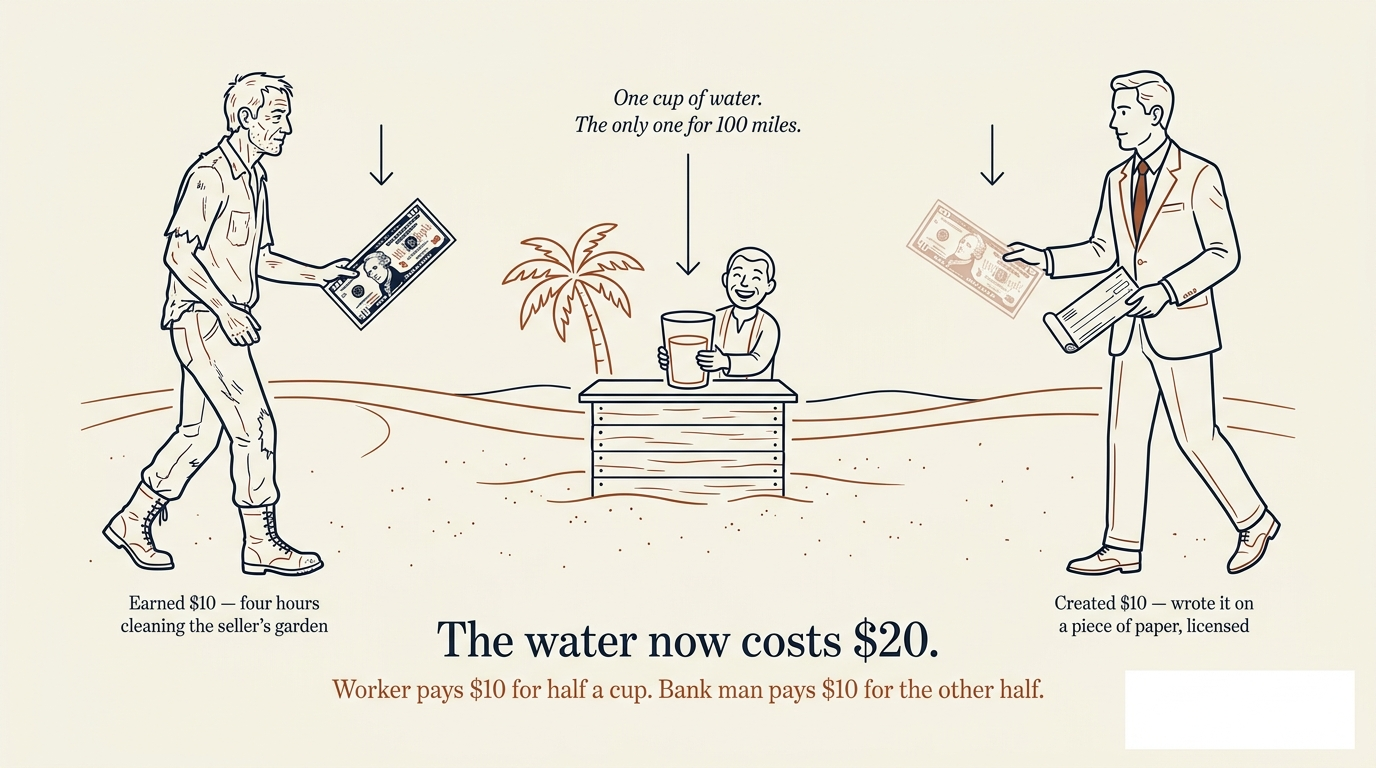
The second man — the one with the chequebook — gets the other half. For something he wrote on a piece of paper, that did not exist a minute ago, that cost him nothing to produce.
Both men drink. Both men live. Neither man complains because both men are too thirsty to argue.
But something has happened in that desert that, when you scale it up by a hundred million transactions, is the whole story of inflation.
What Just Happened
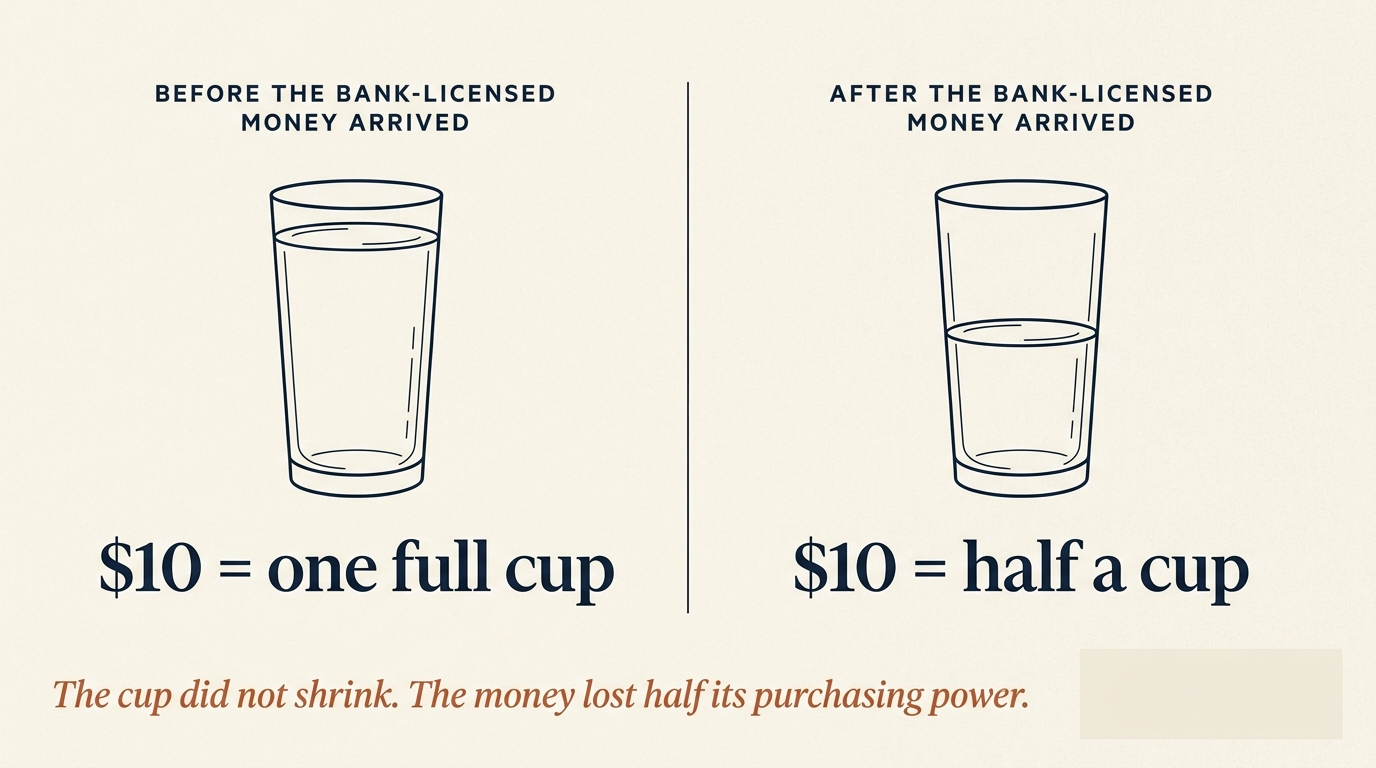
Three minutes ago, ten dollars bought a full cup of water. Now, ten dollars buys half a cup.
The cup didn’t shrink. The water didn’t change. The world did not somehow grow more arid between transaction one and transaction two.
What changed is the amount of money in the market.
What Inflation Actually Is
The price of goods rises when more money enters the market without more goods.
Not an act of nature. Not a shock from outside. Not “global supply chain issues.” Just more money chasing the same goods.
There was ten dollars in the desert, chasing one cup of water. The cup cost ten dollars. Now there are twenty dollars in the desert, chasing the same one cup of water. The cup costs twenty dollars. The price of water doubled — not because anything about water changed, but because the supply of money chasing it doubled.
That is what inflation is.
The doubling was caused by the bank man’s chequebook. Without his arrival, the lost man would have bought his full cup for ten dollars and lived. With his arrival, the lost man gets half a cup for ten dollars and is half as well off.
Who Won, Who Lost
Look at who walked away from that stand with what.
The bank man stole nothing from anybody, technically. Nothing was taken from the worker’s pocket. The worker’s ten dollar note is still in his pocket.
But the purchasing power of his ten dollar note was cut in half. Half of what he earned by cleaning that garden has been transferred to the bank man — silently, with no transaction the worker could refuse.
That is the trick.
A Quiet Invitation
If the desert is starting to make sense, the next post in your inbox is the one you’ll want.
Inflation, In Plain English
Now run that desert thought experiment across an entire economy.
The Australian banking system creates roughly $400-500 billion of new money each year, through loans. Every dollar of that new money enters the market and starts chasing the same finite supply of goods and services — the same houses, the same petrol, the same hospital beds, the same grandfather clocks.
The result is what the desert stand showed us: prices rise. Not because anything about the goods changed, but because the supply of money chasing them grew.
Your wages did not keep up. Your wages grew by 3% if you were lucky. The money supply grew by 7%, 8%, 10% — depending on the year. Every year that this is true, you go slightly backwards in real purchasing power.
You did the work. You earned the dollars. But while you were working, somebody, somewhere, was writing more dollars onto a piece of paper, with a licence. And those new dollars stood next to yours in the market, chasing the same goods, halving what your work bought.
You were not robbed in the way the law recognises robbery. Nothing was taken from your pocket. The notes in your wallet are still in your wallet.
But half of what those notes used to buy has been taken from you, and given to whoever held the new money first.
Inflation is not an accident. It is the natural and predictable consequence of allowing one party to add to the supply of money in a market without adding to the supply of goods.
— The single sentence to remember from this post.
If that sentence is true — and the desert stand shows you why it is — then every person who holds money is being silently and continuously taxed by every person who is allowed to create money. The tax is invisible because nothing is taken from your wallet. But your wallet, every year, buys less.
This is the operating principle of the system.
It is the reason your grandfather bought a house on one wage and raised four children. It is the reason you cannot do the same on two wages and one child. Not because you are working less hard than he did. Because the supply of money in the market has been growing faster than the supply of houses, ever since the bank-licensing arrangement that began in 1694 became universal.
Three Questions Everyone Should Ask
The desert thought experiment is built to make these three questions impossible to dodge.
Why This Blog Exists
The desert thought experiment is not new. It has been used by sound-money writers for two centuries. It almost never appears in mainstream financial press because mainstream financial press is funded by the institutions whose business model the experiment exposes.
NoticedYet exists to put thought experiments like this one in front of working people in plain English, with primary sources, with no products endorsed and no politicians backed. The villain is always the banking licence, never any group.
Get The Next Post By Email
One plain-English post at a time. No tracking pixels. No advertising. Unsubscribe in one click. Your email goes to [email protected] and nowhere else.
Have you noticed yet?
Frequently Asked Questions
Why don’t I feel inflation as theft?
Because nothing was taken from your wallet. The notes are still there. What was taken is what those notes used to buy. The mechanism is invisible by design.
If inflation is theft, who is the thief?
The party that added new money to the market without adding any goods or services. In Australia, that is overwhelmingly the Big Four commercial banks — they create most new money through lending. The Reserve Bank creates a smaller share through monetary operations.
Doesn’t a little bit of inflation help the economy?
This is the official line. It is loudly disputed by serious economists. Brief version: even at 2% per year, inflation halves the purchasing power of saved money every 35 years. Across an entire working life, the cumulative tax on holders of money is enormous.
What about people whose wages keep up with inflation?
Few wages keep up perfectly. Most wages lag. Even when wages match inflation in nominal terms, the gain is taxed and the saver still loses ground.
Who benefits from inflation, then?
Three groups. First, the entity that created the new money — usually a commercial bank. Second, the borrower with a long-term fixed-rate loan, who repays in cheaper dollars. Third, holders of inflating assets (property, shares) whose nominal prices rise. The saver and the wage-earner — the lost man with his hard-earned ten dollars — bear the cost.
Is there a way to escape it?
At an individual level, partly. Holding real assets (property, productive equity, gold) shields some of your purchasing power. At a societal level, only by reforming the money-creation mechanism itself. The constructive arm of this blog covers the historical proposals — the Chicago Plan, the Vollgeld referendum, sovereign money. None are mystical. All have been seriously argued by mainstream economists.
About The Author
M. Notice
M. Notice writes NoticedYet, a calm, sourced blog about how private commercial banks create money out of nothing and what that means for the rest of us. The pen name is a voice choice, not opsec. Every post is primary-source-anchored. No products endorsed. No politicians backed.
Reach out: [email protected]
Sources
- McLeay, Radia, Thomas. “Money creation in the modern economy.” Bank of England Quarterly Bulletin, Q1 2014.
- Reserve Bank of Australia. “Inflation and its Measurement.” RBA Explainers.
- Reserve Bank of Australia. Statistical Tables — money aggregates (M1, M3, Broad Money) historical series.
- Australian Bureau of Statistics. Consumer Price Index, Australia — historical series.
- Murray N. Rothbard. What Has Government Done To Our Money? Mises Institute (free PDF).
- Joseph Huber. Sovereign Money: Beyond Reserve Banking. Palgrave Macmillan, 2017.
- Verein Monetäre Modernisierung (MoMo). Vollgeld-Initiative documentation, 2018 referendum materials.
Information about the banking system, money supply, and regulation changes over time. Linked content may move or be updated without notice. This article is general information and analysis only and is not financial advice. Always seek advice suited to your personal circumstances from a qualified, fee-only adviser whose interests are not tied to product sales. Please verify the primary sources for yourself — that is half the point.