
The Real Heist Movie Has Not Been Made Yet
Pick any heist movie. The Italian Job. Ocean’s Eleven. Inside Man. Heat. Die Hard. Money Heist on Netflix. Hell or High Water. The setup is always the same. There’s a bank. The bank has money in it. Some clever criminals want to take it. We watch them plan, we admire the planning, but at the end we all agree: the bank was the victim, and the law is what protects us all.
It is a great story. We have been telling it for over a century. And it has trained every one of us to instinctively side with the bank when its property is at stake.
Which is interesting, because the bank’s money is not the bank’s.
This post is the cultural-conditioning counterpart to Money From Nothing, The Cup Of Water, What The Bank’s Credit Card “Risk” Actually Is, Why Your Grandfather Lived Off His Savings And You Cannot, Buying Your Hard-Built Business With Conjured Money, If You Do Not Repay, Who Actually Loses?, and Where The First $380,000 Of Your Mortgage Payments Actually Go. Those posts walked through the mechanism. This one walks through the marketing.
The Movie We Have Been Watching Since 1969
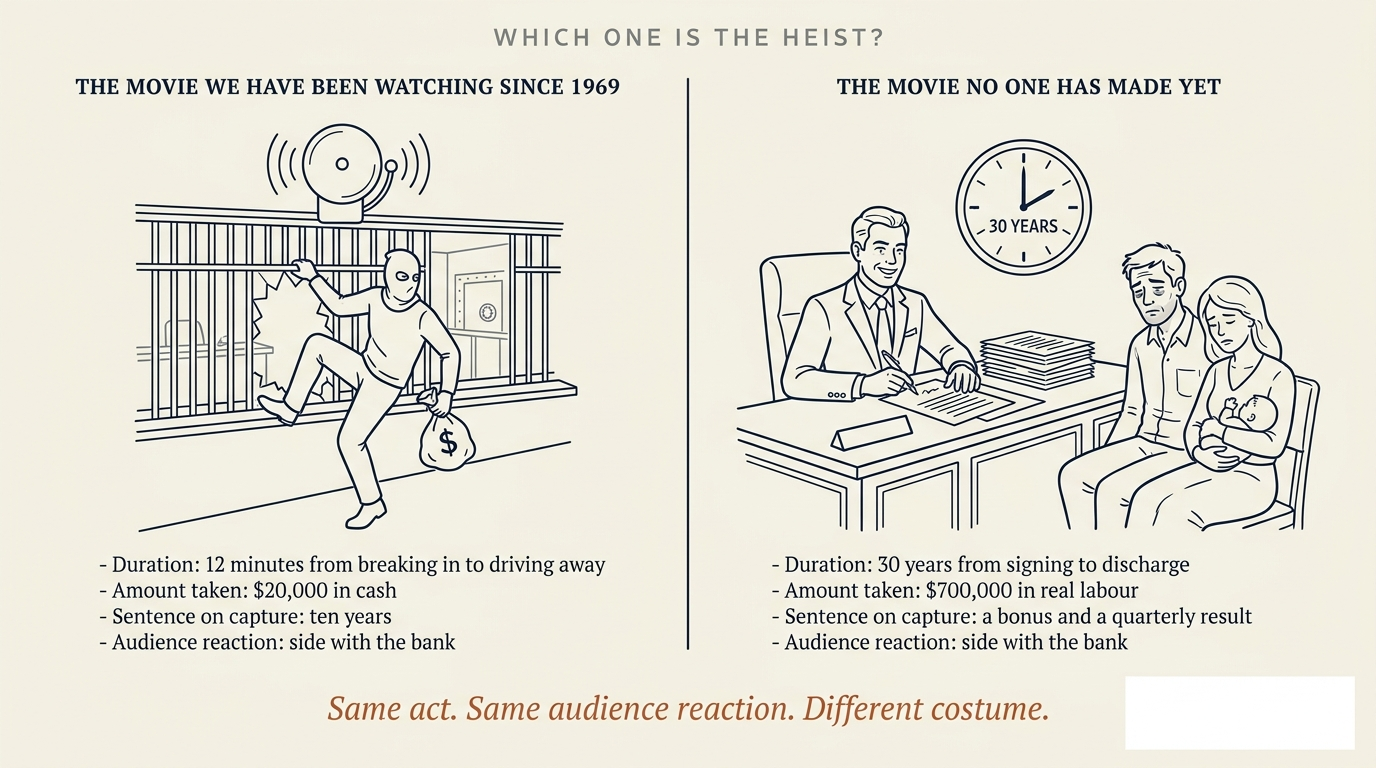
The conventional bank-heist film runs about two hours and follows a strict template. A planner gathers a crew. The crew studies the vault, the alarm, the security routine. They execute. They run. Some get away, some don’t. The bank, the police, and (often) the heroic ordinary teller behind the counter who stood up to the masked men, are the moral centre of the story.
The masked men are charismatic, sympathetic, fun. We are allowed to enjoy watching them work. But at the structural level of the film, they are the antagonists. The bank’s money is the property that has been violated. The film ends correctly when the violation is reversed, or when the antagonists’ violation is punished. We side with the bank.
This is not by accident. Every major Hollywood heist film since 1969 has been financed in part by studios whose parent companies have material relationships with the banking sector. Bank robberies are an exceptionally clean way to tell a thriller story — clear villains, clear stakes, clear resolution — without having to engage seriously with the question of what banks actually do.
By the time the average Australian has been alive for thirty years, they have probably seen twenty bank-heist films and several hundred bank-heist scenes in TV shows. They have been trained to feel the bank’s loss as a violation. They feel it instinctively, before they have time to think about it.
This instinct is the most successful single piece of cultural conditioning the financial sector has produced. It costs them nothing per cinema-goer. It is paid for by the cinema-goer.
The Quiet Reframe
Now picture the same scene with one substitution. The masked men are not climbing through the window. They are sitting in the manager’s office. Wearing suits. Drinking coffee with the manager. Signing papers.
The crew does not run out with $20,000 in unmarked notes. They walk out with the borrower’s signature on a 30-year mortgage that will deliver $1.29 million over its life. The crew did not break in. The crew was invited in. The crew was, in fact, the bank.
The crew did not take money that was the bank’s. The crew typed money into existence and put it on the borrower’s ledger, then took $1.29 million of real labour from the borrower over the next three decades.
The duration is different. The classical movie heist takes 12 minutes. The real heist takes 30 years.
The amount is different. The classical movie heist takes $20,000 in cash. The real heist takes hundreds of thousands of dollars of the borrower’s real future labour.
The legal status is different. The classical movie heist is a crime. The real heist is “responsible homeownership.”
The audience reaction is the same. We side with the bank.
The Conditioning That Has Worked
A century of bank-heist movies has trained us to feel the bank’s loss as a violation. None of them dramatised the actual mechanism by which the bank takes a multiple of the same amount, slowly, with our signed consent.
The framing did not survive because it is accurate. It survived because it is profitable and because no countervailing film has been made.
The Cast Of The Movie Nobody Has Made
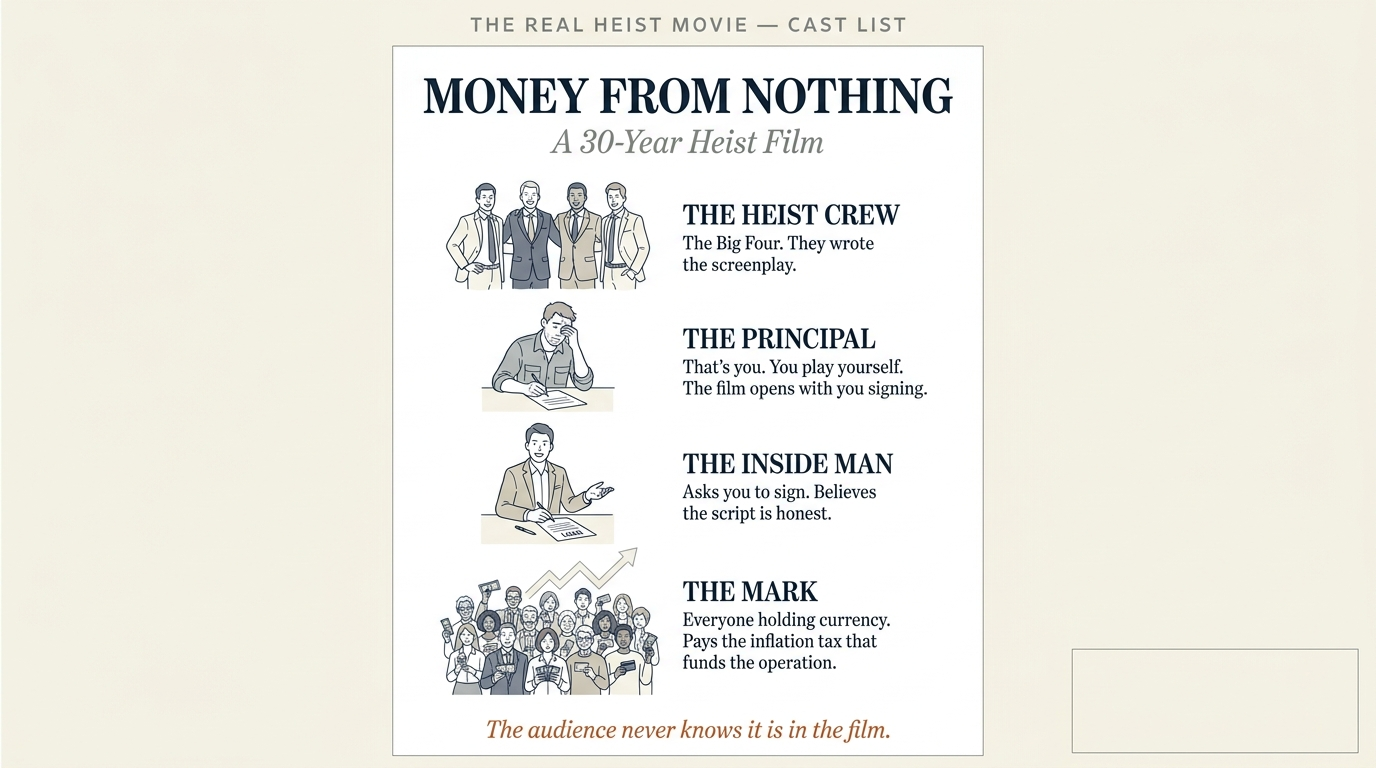
If someone with a budget and a serious screenwriting bench were to make “The Real Heist Movie,” the cast list would be unfamiliar. None of these roles have existing cinematic shorthand.
The Heist Crew. Four bank executives in suits. They did not break anything to get in. They wrote the regulatory environment that lets them perform the act in full daylight. Most of them are pleasant company at parties. Several donate to local sporting clubs. The crew’s screenwriter is the legislation that grants banking licences.
The Inside Man. Your loan officer at the local branch. They are the one who hands you the pen. They believe the script is honest. They have a sales target to make this month. They will get a small bonus if you sign. They are not the villain. They are also, in fact, a victim — their wages have been eaten by the same inflation the system manufactures. They are doing what the system asks them to do.
The Principal. You. You play yourself. The film opens with you sitting in the loan officer’s office, nervous, tired, holding the pen. You think you are about to acquire a home. The film knows you are about to sign over thirty years of your future labour. The film cannot tell you. The next scene is sad and contains the math.
The Mark. Everyone in the country holding currency. They are not in the loan office. They are not in the bank. They are at home, at work, at the supermarket, watching their groceries cost slightly more each month. The film cuts to them at intervals over the 30-year run-time. They never know they are in the film. They pay the inflation tax that, in the cumulative, funds the entire operation.
The pacing of this film is the problem. There is no thrilling vault break-in. There is no clever escape. The drama is slow, structural, and depressingly normalised. The audience would have to be unusually attentive to recognise what they are watching.
This is precisely why no one has made it. Not because it is uninteresting — it is the most interesting financial story of the last 300 years — but because the existing cinematic grammar does not let an audience feel theft when the theft is consensual, slow, and dressed in the costume of normal commerce.
A Quiet Invitation
If this is the first time you have seen every heist movie you ever watched as part of the trick, get the next post in your inbox.
Why The Movie Has Not Been Made
Three reasons.
One. Banks are large advertisers and minority financiers of media. Australian commercial banks are among the largest spenders in mainstream Australian media every year. The networks that would carry such a film, and the streaming platforms that would commission it, are linked at the corporate level to financial services. No commissioning editor wants to be the one who greenlit “the film that exposed our largest advertiser.”
Two. The existing cinematic grammar cannot dramatise slow theft. A heist film requires a clear act, in a clear room, with a clear victim. The real heist is distributed across millions of consensual transactions over decades, with the “victim” believing they are participating in commerce. The form of cinema that exists is poorly suited to the form of theft that exists. Someone would have to invent a new grammar to make the film work.
Three. The audience is not yet ready. A film only works if the audience can feel what the film wants them to feel. A film that asks the audience to feel cheated by a bank when the bank has not broken any visible law, has not raised its voice, has not made anyone leave the office — that film requires an audience that has already internalised the structural critique. Most audiences have not. They are still watching the masked man and instinctively rooting against him.
This blog exists, in part, to change that. If enough plain-English explanations of the mechanism land in enough public minds, the audience for the real heist film will eventually exist. It will take years. The work is worth doing because the structural understanding it produces survives the absence of any single film.
Same act. Same audience reaction. Different costume. The masked man wore a stocking and ran. The bank wore a suit and stayed.
— The structural sentence of the post.
The Working Class Heroes Of Real Heist Films
The few films that come closest to dramatising the real heist do so by accident, or in a register the audience does not recognise as a heist film.
The Big Short (2015) showed the 2008 financial crisis in a way that briefly made the audience feel the trick. It was framed as a financial drama, not a heist. The audience left the cinema confused and slightly angry but did not connect the systemic critique to their own mortgage.
Margin Call (2011) showed the moral architecture of an investment bank in extremis. It is the closest cinema has come to a film that lets the audience see the structural villain clearly. Almost nobody watched it.
Hell or High Water (2016) made the bank explicitly the villain — the bank as foreclosure machine, the bank as the heir of generational wealth destruction. It cast the bank robbers as folk heroes. The reviews framed this as a brave subversion. It was a small step toward the real heist movie. The audience for it was small.
None of these films were marketed as the heist movie they really were. Hollywood does not yet know how to sell the real one. The genre code — planner, vault, alarm, getaway — is not flexible enough to dramatise consensual extraction over thirty years.
The film will eventually be made. The maker will probably not be Hollywood.
Three Questions Everyone Should Ask
The heist-movie inversion is built to make these three questions impossible to dodge.
Get The Next Post By Email
One plain-English post at a time. No tracking pixels. No advertising. Unsubscribe in one click. Your email goes to [email protected] and nowhere else.
Have you noticed yet?
Frequently Asked Questions
Is this a conspiracy theory about Hollywood?
No. No smoke-filled room. The conditioning is structural — banks are large advertisers, banks are connected through holding companies to media companies, and the heist genre is profitable because it dramatises a clear villain. No coordination is necessary. The effect emerges from incentives.
Aren’t heist movies just entertainment?
They are entertainment, and they are also the medium through which most people develop their instincts about banking. A century of repeated framing, even framed as entertainment, shapes the moral default. The default is “the bank is the victim.” That default does load-bearing work in every real-world conversation about banking reform.
What about robberies that DO happen at real banks?
They are crimes and should be prosecuted as crimes. The point is not that physical robberies should be condoned. The point is that the cultural saturation of “bank as victim of theft” trains audiences to feel violation in a direction that masks the much larger, slower extraction the bank performs in the legal direction.
What about heist films that show banks as the bad guys?
There are a few. Hell or High Water (2016) is the cleanest example. They are rare, generally critically respected, and rarely make box office returns matching the conventional template. They also tend to frame the bank as a foreclosure villain rather than a money-creation villain — one step closer to the real heist, but not all the way.
Wouldn’t a film like the one you describe be too didactic to work as cinema?
Possibly with a Hollywood treatment. With the right filmmaker — someone like Adam McKay, who made The Big Short — or in a documentary form, or in episodic television, the structural extraction could be made cinematic. It would require treating the wage-earner as the protagonist rather than the loan officer, and treating time itself as the antagonist rather than a vault.
What can I do as a viewer?
Watch the next heist movie you happen across with the inversion in mind. Notice the instinct to side with the bank. Notice whose property has been violated and whose has been preserved. The instinct itself, once seen, becomes harder to fall back into. That recognition, multiplied across audiences, eventually changes which films get commissioned next.
About The Author
M. Notice
M. Notice writes NoticedYet, a calm, sourced blog about how private commercial banks create money out of nothing and what that means for the rest of us. The pen name is a voice choice, not opsec. Every post is primary-source-anchored. No products endorsed. No politicians backed.
Reach out: [email protected]
Sources
- McLeay, Radia, Thomas. “Money creation in the modern economy.” Bank of England Quarterly Bulletin, Q1 2014.
- Australian Communications and Media Authority. Advertising spend and media sector statistics.
- Australian Film Commission. Industry reports on Australian feature film production and financing.
- Hell or High Water (2016) — one of the few films to explicitly frame the bank as villain.
- The Big Short (2015) — structural look at the 2008 financial crisis.
- Margin Call (2011) — the closest cinema has come to dramatising the moral architecture of an investment bank.
- Joseph Huber. Sovereign Money: Beyond Reserve Banking. Palgrave Macmillan, 2017.
This article is general commentary and analysis. Films referenced are widely distributed commercial works. Critical opinions are the author’s. Linked content may move or be updated without notice. This article is not legal, financial, or media advice. Please verify the primary sources for yourself — that is half the point.